Kontrol ve Yerleştirme Fikstürü DoğrulamaChecking & Locating Fixture Verification
Bir fikstürün CAD modelini alıp "parça gerçekten yerine oturur mu, klemp doğru yere basar mı, parça sonra çıkarılabilir mi" sorularını otomatik yanıtlayan bir Python paketi. Fikstürdeki her gövdenin rolünü bildirirsiniz (parça, datum pedi, pim, klemp, kontur bloğu, mastar); paket geometriden ölçüp her kontrol için geçti/kaldı raporu verir.A Python package that takes a fixture CAD model and answers, automatically, "does the part really seat, does the clamp press in the right place, can the part be taken out again". You declare the role of each body in the fixture (part, datum pad, pin, clamp, contour block, gauge); the package measures the geometry and reports pass or fail for every check.
- TestTests
- 101
- SürümVersion
- 0.1.0
- Örnek fikstürExample fixtures
- 2
- Hatalı varyantFault variants
- 9
ProblemProblem
CAD programının söylediği "katı geçerli, çakışma yok" bilgisi bir fikstürün işe yaradığını göstermez. Elmas pim 90° dönük modellenmiş olabilir, klemp altında ped olmayan ince sacı bastırabilir, bir blok tabana değmeden havada durabilir, pim en kötü tolerans durumunda deliğe girmeyebilir ya da parça yerine konduktan sonra hiçbir yönden çıkarılamayabilir. Bunların hiçbiri çakışma kontrolünde görünmez.
Fikstürü bir insan da bir yapay zekâ ajanı da tasarlasa bu hataların modelden, üretime geçmeden yakalanması gerekiyor. Hedef, bunları tek tek gözle aramak yerine tekrar çalıştırılabilir bir kontrol listesine çevirmekti.
"Valid solid, no interference" from the CAD program does not show that a fixture works. A diamond pin can be modelled rotated 90°, a clamp can press thin sheet with no pad under it, a block can float above the base, a pin may not fit the hole at worst-case tolerance, or the part may have no direction to come out once it is loaded. None of these show up in an interference check.
Whether a person or an AI agent designs the fixture, these errors need to be caught in the model, before anything is made. The goal was to turn them into a check list that can be run again, instead of hunting for them by eye.
YaklaşımApproach
- Rolleri bildir, gerisini paket ölçer. Fikstür bir STEP montajından ya da build123d gövdelerinden yüklenir. Kullanıcı yalnızca hangi gövdenin A datum pedi, yuvarlak pim, elmas pim, klemp, kontur bloğu ya da mastar olduğunu ve deliklerin toleranslarını yazar.
- Geometriden ölçüm. Temas yüzeyleri, pim kesitleri, klempin bastığı noktanın pede izdüşümü ve gövdelerin birbirine bağlantısı doğrudan modelden çıkarılır; elle girilen ölçü yok.
- Hareket kontrolleri. Klemp kolu mafsal ekseni çevresinde 1° adımlarla açılır ve her adımda çarpma aranır. Parça, açık konumdaki klemplere karşı belirtilen yönde süpürülerek çıkarılır. GEÇER/GEÇMEZ mastarı burç içinden deliğe kadar sürülür.
- Mevcut araç üstünde ince katman. Paket kendi hesaplarını cad-khana'nın iddia sistemine ekler; çıktı bir cad-khana montajı olduğu için
khana checkvekhana showdoğrudan çalışır.
- Declare roles, the package measures the rest. The fixture is loaded from a STEP assembly or from build123d bodies. You only write which body is a datum A pad, round pin, diamond pin, clamp, contour block or gauge, and the hole tolerances.
- Measured from geometry. Contact patches, pin cross-sections, where the clamp's pressure falls on a pad, and how the bodies connect to each other are all taken from the model; no dimensions are typed in by hand.
- Motion checks. The clamp arm opens around its pivot in 1° steps, looking for a collision at each step. The part is swept out in the given direction against the clamps in their open positions. The GO/NO-GO gauge is driven through its bushing into the hole.
- A thin layer on an existing tool. The package adds its own checks to cad-khana's assertion system; the output is a cad-khana assembly, so
khana checkandkhana showwork directly.
Neyi denetliyorWhat it checks
| Kontrol | Ne arar |
|---|---|
| 3-2-1 yerleştirme | Tam üç ped temasta ve aynı düzlemde mi; destek üçgeni yeterince geniş mi; kısıtlanan serbestlik derecesi tam 6 mı |
| Pimler | ISO 286'ya göre en kötü durum boşluğu, CAD ekseni kaçıklığı düşülmüş boşluk, datum kayması; elmas pimin rahatlatması B→C doğrultusunda mı |
| Klempler | Basma noktası bir pedin üstüne mi düşüyor, arada dolu malzeme var mı; kol açılırken parçaya ya da sabit gövdelere çarpıyor mu |
| Bağlantı | Her fikstür gövdesi tabana temasla bağlı mı (havada kalan blok yok) |
| Parça çıkarma | Parça, klempler açıkken belirtilen yönde engelsiz çıkabiliyor ve fikstürün tamamen dışına geçebiliyor mu |
| Mastar | GEÇER çapı sanal durumda, GEÇMEZ çapı en az malzeme durumunda mı; yol burç ve parça dahil açık mı; burç eş eksenli ve L/D yeterli mi |
| Check | What it looks for |
|---|---|
| 3-2-1 location | Exactly three pads in contact and coplanar; a wide enough support triangle; exactly 6 degrees of freedom constrained |
| Pins | Worst-case clearance per ISO 286, clearance with the CAD axis offset deducted, datum shift; diamond pin relieved along B→C |
| Clamps | Pressure point lands on a pad with solid material in between; the arm does not hit the part or fixed bodies while opening |
| Connection | Every fixture body is connected to the base by contact (no floating blocks) |
| Part removal | With the clamps open, the part can leave in the given direction unobstructed and get clear of the whole fixture |
| Gauge | GO diameter at virtual condition, NO-GO at least material condition; clear path through bushing and part; bushing coaxial with enough L/D |
DoğrulamaVerification
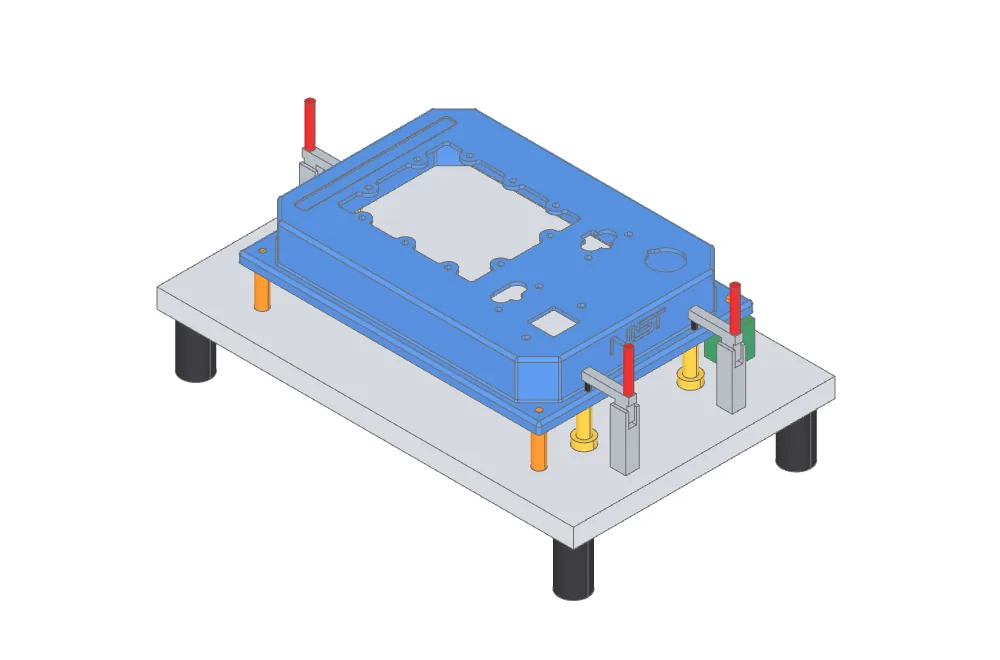
İki örnek fikstür var: STEP'ten yüklenen 28 gövdeli bir sac braket kontrol fikstürü (üç mandallı klemp, kontur blokları, burç kılavuzlu mastar) ve NIST FTC-08 parçası için kodla kurulan fikstür. Her ikisi de temiz hâlde tüm kontrollerden geçiyor; ardından bilerek bozulmuş varyantların her biri belirli bir kontrolde kalmak zorunda:
| Bozulma | Yakalayan kontrol |
|---|---|
| Elmas pim 90° döndürülmüş | Elmas pim yönü |
| Elmas pim hiç konmamış | Serbestlik derecesi (5/6) |
| Pim Ø9 js6 seçilmiş | En kötü durum boşluğu |
| Klemp pabucu 14 mm öne kaymış | Klemp ped üstünde değil |
| Burç kulesi 5 mm yüksek | Tabana bağlantı |
| Burç ve mastar 1 mm sola kaymış | Mastar yolu |
| Kontur bloğu parçanın üstüne uzanmış | Parça çıkarma, boşluk |
| FTC-08: klemp mafsalı ucun üstünde | Klemp açılması |
| FTC-08: gevşek yerleştirme pimi | Datum kayması |
101 test her kontrol için geçen ve kalan durumları, ISO 286 tablo değerlerini ve dokuz hatalı varyantı kapsıyor; GitHub Actions her değişiklikte çalıştırıyor.
There are two example fixtures: a 28-body sheet-metal bracket checking fixture loaded from STEP (three toggle clamps, contour blocks, a bushing-guided gauge) and a fixture built in code for the NIST FTC-08 part. Both pass every check when clean; then each deliberately broken variant has to fail on a specific check:
| Fault | Caught by |
|---|---|
| Diamond pin rotated 90° | Diamond pin orientation |
| Diamond pin left out | Degrees of freedom (5/6) |
| Pin specified Ø9 js6 | Worst-case clearance |
| Clamp pad shifted 14 mm forward | Clamp not over a pad |
| Bushing tower 5 mm too high | Connection to base |
| Bushing and gauge shifted 1 mm left | Gauge path |
| Contour block reaching over the part | Part removal, clearance |
| FTC-08: clamp pivot above the tip | Clamp opening |
| FTC-08: loose locating pin | Datum shift |
The 101 tests cover passing and failing cases for every check, ISO 286 table values and the nine fault variants; GitHub Actions runs them on every change.
SınırlarLimits
Nominal geometri denetlenir; toleranslar yalnızca pim-delik geçmelerinde ve mastar çaplarında hesaba girer, tolerans zinciri analizi yok. Kuvvet analizi, operatör erişimi ve imal edilebilirlik kapsam dışı. Klemp açılması 1° adımlarla örneklendiği için iki adım arasındaki çok ince bir engel kaçabilir.
Nominal geometry is checked; tolerances enter only in pin-hole fits and gauge diameters, and there is no tolerance stack-up. Force analysis, operator access and manufacturability are out of scope. Clamp opening is sampled in 1° steps, so a very thin obstacle between two steps could be missed.
Diğer projelerOther projects
Süreç Yeterliliği ve SPC Analiz AracıProcess Capability & SPC Analyzer
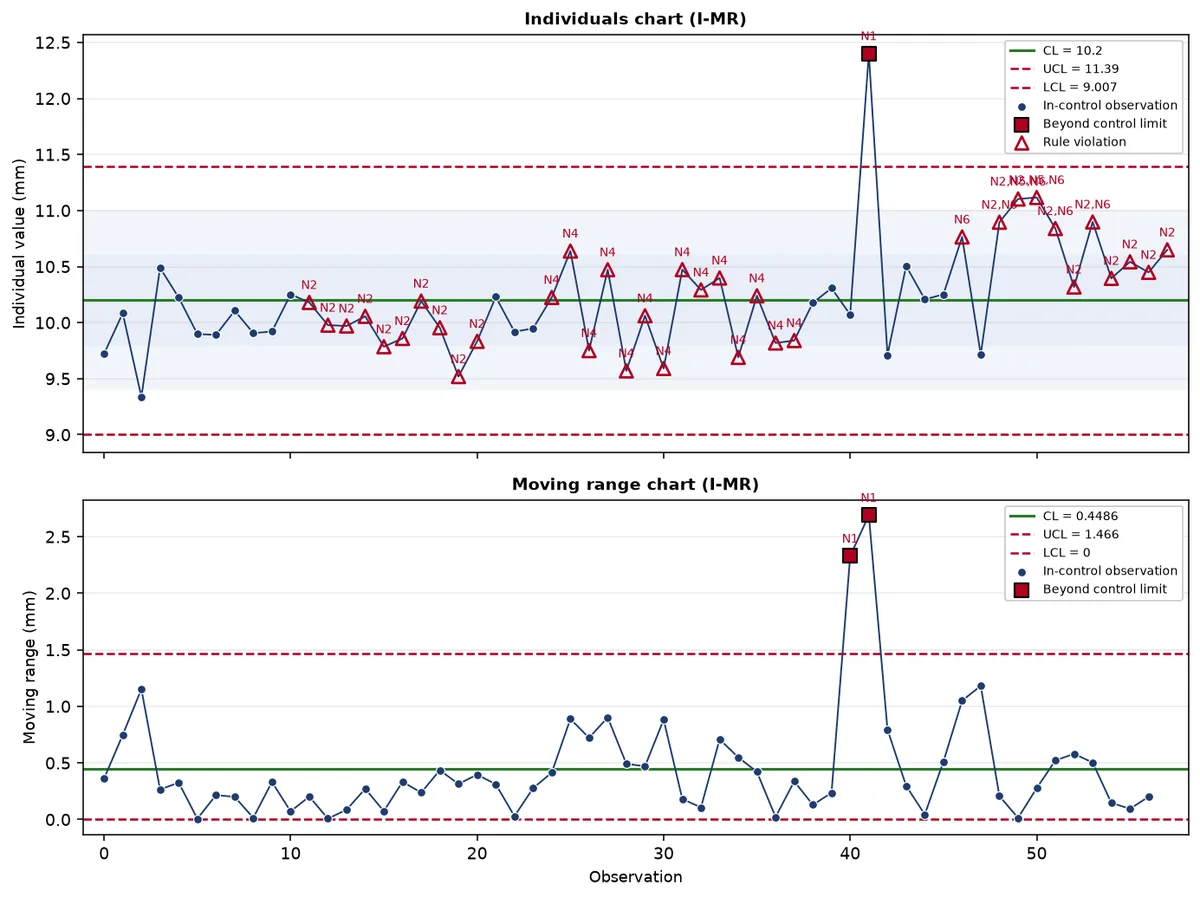
X̄-R, X̄-S, I-MR ve nitelik (p, np, c, u) kontrol grafikleri; Faz I / Faz II limitleri; 4 Western Electric + 8 Nelson kuralı; Cp/Cpk (grup içi) ve Pp/Ppk (genel), normal olmayan veri için de; Type-1 (Cg/Cgk) ve çapraz Gage R&R (ANOVA ve AIAG ortalama-aralık). Yeterlilikten önce ölçüm sistemini ve kararlılığı denetler, yorumları kural tabanlı üretir, CSV/Excel/PDF rapor verir. Montgomery, Minitab, SAS ve Bosch'un yayınlanmış sonuçlarına karşı doğrulandı.X̄-R, X̄-S, I-MR and attribute (p, np, c, u) control charts; Phase I / Phase II limits; 4 Western Electric + 8 Nelson rules; Cp/Cpk (within) and Pp/Ppk (overall), also for non-normal data; Type-1 (Cg/Cgk) and crossed Gage R&R (ANOVA and AIAG Average & Range). Checks the measurement system and stability before capability, produces rule-based interpretations and CSV/Excel/PDF reports. Validated against published Montgomery, Minitab, SAS and Bosch results.
Hoffmann Montaj Hattı DengelemeHoffmann Assembly Line Balancing
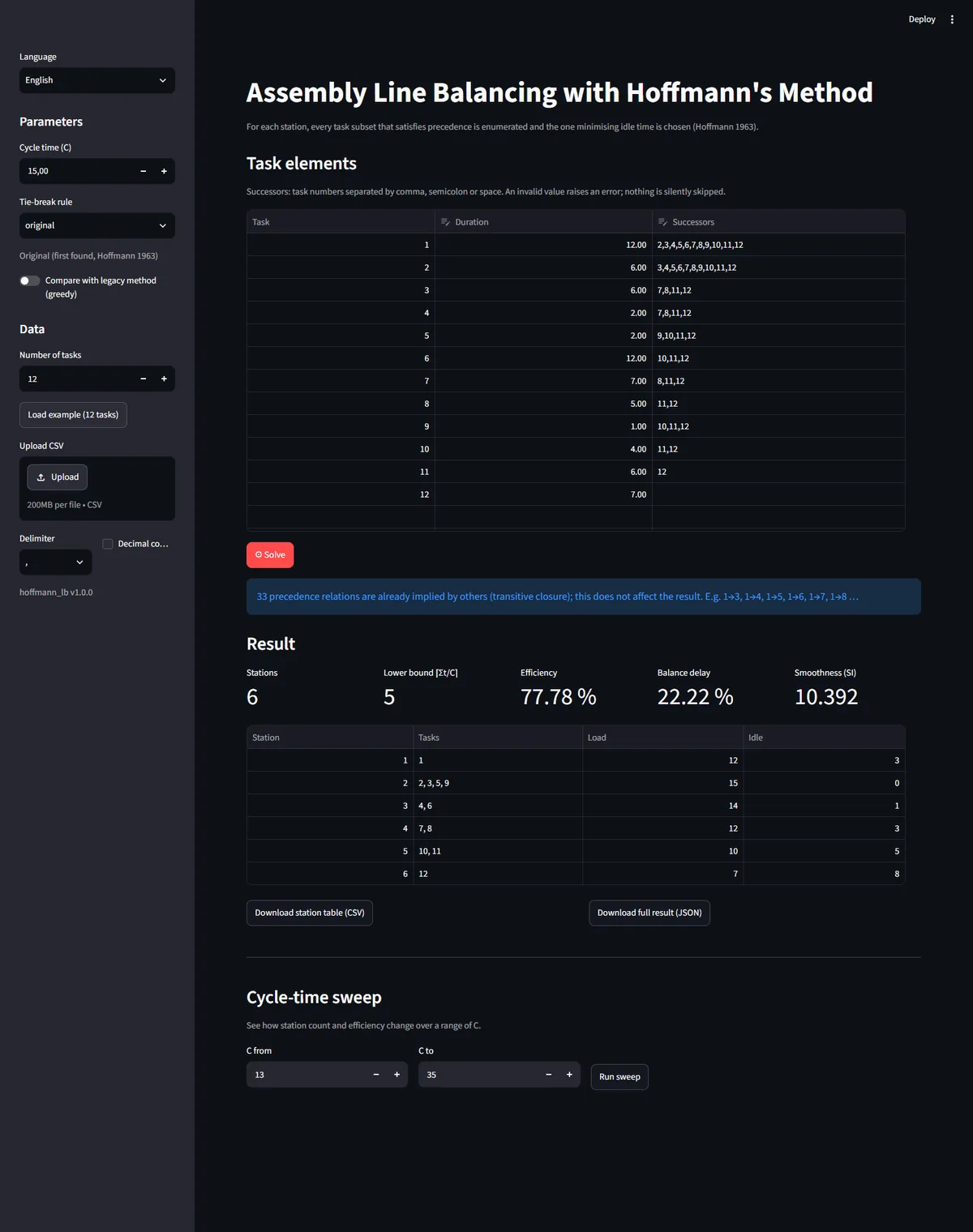
SALBP-1 için Hoffmann (1963) öncelik matrisi yöntemi: her istasyon için uygun tüm alt kümeleri sayar. Komut satırı + beş dilli Streamlit arayüzü, çevrim süresi taraması. Brute-force ve bitmask-DP çözücülerle çapraz doğrulandı; ders ödevi olarak başlayan kodun aslında first-fit olduğu görülünce sıfırdan yazıldı.Hoffmann's (1963) precedence-matrix method for SALBP-1: enumerates every feasible subset per station. CLI + five-language Streamlit UI, cycle-time sweep. Cross-checked against brute-force and bitmask-DP solvers; rewritten from scratch after a review showed the original coursework code was first-fit, not Hoffmann.